Friday, October 17, 2014

Failure, Fondness, and the Few Remaining Wonders of the Chicago World's Fair


Earlier this week I mentioned a point where I was not so timely in getting to an exhibit.  That time—more specifically, a 9-month span—was my failure to make it to the “Opening the Vaults: Wonders of the 1893 World’s Fair” exhibit on the 1893 World’s Columbian Exposition at the Field Museum.  It was a failure of epic proportions, truly.  In typical fashion, I waited until the absolute last day of the exhibit to attempt to go—a day which also happened to be the home opener for the Chicago Bears’ 2014 season.  I waited until 3:00pm on this day to try to go to the Field Museum—a time which also happened to coincide with the end of the Bears’ loss that day.  So I ended up waiting some more, in traffic, for two hours—the first hour trying to venture eastbound to get the Museum campus (to no avail), the second hour in more traffic trying to get home (I live approximately 5 miles away).  So with all this free time to spend in gridlock, I got to thinking about what I’ve already seen from the Chicago World’s Fair – the 1893 World’s Columbian Exposition. 


Several changes have been made to the city since 1893.
Turns out, I’ve been to a few attractions already this summer.  First we’ll start off with my most recent ride on the Ferris Wheel at Navy Pier.  To clarify, this is not the original Ferris Wheel that was built purposely for the fair—that one was dismantled in 1894, relocated and eventually demolished.  The Ferris Wheel at Navy Pier stands in honor of that Original, however.  At least, that’s what the radio tour that plays during the ride would have you believe.  There is actually little relation between the two attractions.  Whereas the Navy Pier Ferris Wheel stands at 150 feet high, the Original was a whopping 264 feet tall, a fact that literally made me get butterflies as it was recited to me from above Navy Pier via the radio inside the gondola (view on the right!). Nor are the sites of the two wheels close.  The Original was located on what is now park ground next to the University of Chicago campus in Hyde Park – a stretch that still maintains its original name from the fair: The Midway Plaissance. 


Osaka Garden - a view of the Moon Bridge

Actually, Hyde Park is the location that holds most of the remnants of the 1893 World’s Fair.  That is where you will find the Osaka Garden, near the lake right off of the Midway Plaissance.  Located in Jackson Park on the Wooded Isle, this garden was constructed as an exhibit in the Fair, at the behest of the Japanese government.  While the garden remains located on the original location from 1893, it had to be reconstructed after having been vandalized during WWII.  Turns out the park has an interesting history of its own (which you can read about here).  What stands today is what you can see here in these pictures I took: a beautiful Japanese strolling garden, with several ponds, a waterfall, plants, trees, a Moon bridge, and the pavilion a few steps away.  From this view, only steps away from the lagoon the garden shares with the Museum of Science and Industry overlooks, it is easy to imagine how the grounds may have looked in 1893. 


Can't you picture the gondolas?
The Museum of Science and Industry is located in a building which originally was the Palace of Fine Arts for the Fair.  During the Fair, the South entrance of the building was the main entrance, where visitors sailed up in gondolas from the North Pond (today known as the Columbia Basin, which is part of the lagoon the building sits on).  While the Museum of Science and Industry is indefinitely worth a visit of its own accord (which we will grant soon enough), this fine summer day I visited, I could not help but imagine what the building was like during the 1893 World’s Fair.  It was the inspiration for this wistful picture you see here (personally, I think it was mildly cruel of the museum to leave these doors open and forbid people to walk out through them).  Never have I felt more nostalgic than on this day at the South entrance of the Palace of Fine Arts.  It literally pains me to look at the breathtaking pictures from the Columbian Exposition (particularly the images of the Court of Honor) and know that we have so little left of those many works of art.   Add to that my failure to visit those few remaining wonders at the Field Museum exhibit… Talk about pain!

Tuesday, October 14, 2014

Live-Action Frogger: Navigating "The Mystery of the Ordinary" at the Art Institute

Magritte: The Mystery of the Ordinary 1926-1938 at the Art Institute of Chicago
While many people were reaching their personal bests in the Chicago Marathon Sunday morning, I was also able to accomplish a personal goal:  getting to an exhibit before it closed!  (Our next post will share an instance I was not so timely) Magritte: The Mystery of the Ordinary 1926-1938 closed yesterday at the Art Institute of Chicago, and I was able to sneak in before they shut the doors on it!

Confession:  I hate big exhibits like this, only because of the throngs of people snaking through the gallery trying to get by.  It’s disruptive to a good gallery experience—too many irksome things going on to really be able to connect with the works.  It was very dumb of me, then, to wait until Magritte’s final days to go see it, as the crowds were even heftier than usual.  Actually, the Chicago Marathon provided a great foil to this exhibit experience: the participants outside running freely through the streets of Chicago, compared to the dozens of people inside the Art Institute slowly shuffling through cramped quarters in The Mystery of the Ordinary.

Those Darn Audio Tour Devices!
Add on to this my introduction to the new/different audio tour devices, and the experience was mildly aggravating.  Approaching Regenstein hall, I thought it odd there was a crowd of people on their cell phones standing in front of the exhibit introduction label.  Imagine how angry I was when all of those same people were still on their phones inside the gallery!  At some point I realized that these people were not cell phones, but in fact the devices used for the audio tours for the exhibit.  At a closer glance, the devices sort of looked like calculators or maybe a large cordless house phone.  The tour was rather loudly playing out of the speakers of the “personal” device, which made it hard for the audio to be controlled. What was odd to me was that none of them came with headphones…so the audio tour really was available to everyone in the gallery for the exhibit (whether or not you wanted that), if you weren’t already distracted by the ever-glowing light of the devices.  I was amazed that the stewards inside the gallery were able to pick out the cell phones from all the audio tour devices!

That said, the exhibit itself was very well done.  AIC made great use of the sheer space of the gallery in terms of placement of the works.  Although the exhibit only covered Magritte’s works from a 12-year period, there were many, many paintings to be displayed—what a prolific artist he was!  Fortunately each work was given ample space for consideration, and I loved the way the moody gray paint really let Magritte’s colorful works shine all on their own.  Although I did not receive the time with each painting that I would have liked, it was very easy to grasp that Magritte’s ideas are timeless and provocative. “The False Mirror” (the giant, round eyeball reflecting clouds) is among my favorite works of his for this very reason – it’s just so meta.  It was quite something to see in person.  With “The False Mirror” and Magritte’s other works, it is easy to think that his painting is rather straightforward appearance-wise, given that his subject matter tends toward the use of everyday items presented in an unconventional method.  Viewing these pieces online, for instance, gives you zero clue as to his incredible way with depth and distance.  In person, the clouds on/in/against the iris of “The False Mirror” leap off the canvas; you feel like you could fall into the eye itself, it looks so dimensional. 

A view of "The Gigantic Days," from behind some tall people
This was also true of seeing “Time Transfixed” in person.  That train protruding from the fire place also truly appears to be jutting out at you leaping off the canvas.  Take if you will a picture of this particular moment, to get a sense of this exhibit experience: there I am, attempting to follow the steward's advice at viewing “Time Transfixed” from the left of the picture and then the right (so as the highlight the genius and presence of that train).  There, too, are 3 groups of 5 people stationed in front of the painting, so I try to go from left to right, blocked by the middle group of people.  I try to go around that middle group of people, think I am in the clear, when another person cuts me off and I have to veer yet again out of the way.  Who knew one would need such navigational skills inside an exhibit!  It was not unlike live-action Frogger… Left, Right, and then out the door to relish the fresh air and personal space!

Tuesday, October 7, 2014

The Great Chicago Fire Festival: Fizzle on the River

As you’ve heard by now, the inaugural Great Chicago Fire Festival ended up being anti-climactic.  It was the best-attended portion of the festival (whose day-time festivities included crafts, food trucks and several small performances), but in basic terms, the crowds really came out to see stuff get lit up. Who wouldn’t love a pyro parade!  Thousands (me, more importantly) braved the cold Saturday night to catch a glimpse of an inferno on the river.  That spark never caught on, due to electrical problems, the precipitation that week, etc.  You’ve already read all about that, I’m sure, so you’ve probably also seen the backlash about the night being an epic flop.  But, I am writing to defend the Festival, despite all of the glitches.   

The parade started off on the right foot.  Stage lighting cast different colors upon the 1800-style house floats, in anticipation of the flames they was supposed to have been lit up with later.  Rob Stafford emceed the symbolic lighting of the neighborhood cauldrons, which were then trailed down the river for all to see.  A steamship-inspired boat floated down and puffed some preliminary flames for the crowds (which ultimately seemed more Halloween-appropriate, given the creepy slow effect, clown-like appearance and accompanying Danny Elfman-sounding music).  Then, the cool part:  the Chicago Children’s Choir performed, perched atop an architecture tour boat.  Having been stationed on Wabash facing westward, I was fortunate enough to witness the opening to this chorus.  It makes for a great clip on our Facebook page!

But from that point on, the flames were supposed to take over, and…nothing happened.  For about 35 minutes, nothing happened.  Just a bunch of folks standing around in the cold waiting to see something while (unfortunately) that creepy Danny Elfman-like song played for a long while (too long).  Eventually Rob Stafford came on to announce the technical difficulties, and eventually the technicians conjured some measly flames on the float that was nearest Wabash.  But the inferno was not to be.   So, lights, cameras, and no action, really, until they ended with the fireworks. 

So, yes, ultimately it was a little disappointing to have the pyrotechnics fizzle.  But there is still a bright side to this whole event.  Note that the weather this evening was pretty cold, still damp, and a little windy.  And yet, many people still came.  Mostly everyone stuck around until the bitter end, despite the wait time and soggy parade floats.  People still enjoyed their hot chocolates, still got their Instagram pictures (guilty), still got to be outdoors amid the bright lights in spite of the depressing weather forecast and looming winter season.  Don’t think that people still didn’t enjoy the evening.  The Festival has plenty of potential to expand upon next year if it is (hopefully) held again—with better organization and more flammable parade floats the spectacle could really take off.  We Chicagoans are already familiar with looking forward to ‘next year’ for a better performance.  What’s another festival to add to the list of sports teams, right?

                                                                                                          
                                                                                                             -Jessica

Wednesday, September 3, 2014

Dancing in the Rain

In the Rain on the Terrace

Earlier we promised posts of summer weather at museums, as an effort to keep good spirits up given the impending end of the season.  Well (as you know), not all summer weather is sunny. The other week at the Museum of Contemporary Art Chicago, there was bad weather again – but our good spirits remained intact!


The draw for visiting the museum that particular day (although, there are many to choose from) was the free Manual Cinema workshop performance being given on the MCA Stage.  We’ve been following Manual Cinema’s work for a bit now, and we were thrilled to see that they are collaborating with the MCA on a performance!  Manual Cinema does truly unique work in puppetry and performance, incorporating live music, editing, and even animation into their work.  They combine all of these elements to accompany their shadow puppets using overhead projectors, producing extraordinary results.  The performance that took place that Tuesday was to a workshop for Mementos Mori, their latest feature length show.


The workshop performance offered us (the lucky 300 or so visitors) a preview of Mementos Mori, with a few scenes from the feature, as well as a discussion afterward with company members, performers and directors.  The feature focuses on how technology in the digital age affects our concept and experiences of death… So in the preview we were given, Mementos Mori featured instances such as texting while bicycling, religious iconography depicting death, and even butchering.  It’s a unique but totally relevant topic, and the imagery presenting these scenarios was just incredible.  Unfortunately, I couldn’t take a photo during the performance for you all to see, but you can peep a few images from Mementos Mori here: http://manualcinema.com/shows-in-rep/mementos-mori/.   Stylistically, this was a performance unlike anything else I’ve ever seen, with the live puppetry, live action, live music and singing.  During the Q&A session held with the team after the performance (which I was able to snap a pic of here), the audience didn’t have questions as much as they did praise for the performers. Everyone left looking forward to the full performance in January as part of the Chicago International Puppetry Festival.


But that’s not where the fun ended!  The workshop performance let out in time to catch the last hour of Tuesdays on the Terrace, the free weekly Jazz concert held on the terrace on Tuesdays during the summer.  As we mentioned before, the weather was bad on this particular day – but the band played on, as they say.  The concert ended up being held inside Puck’s café, which is just inside the terrace.  Despite the rain, we went outside on the terrace anyway (it’s one of the best backyards in Chicago), and saw that the rain did nothing to dampen the spirits of people around the museum: there were still people dancing outside, eating outside, even playing tennis while the rain fell, all to the tunes of Tatsu Aoki and the Miyumi Project.  People milled around the dueling didgeridoos (see right) inside the exhibit halls, peeping the Frida Kahlo and Simon Starling works as the music wafted through the museum.  It was truly a great sensory experience for visitors to the museum that night – and the best part that of the night was that all of the programs were FREE!  We will be back at the MCA soon for the much-anticipated “David Bowie Is” exhibit, along with the rest of Chicago, so stay tuned!                                                                                                                         

                                                                                                                                    -Jessica 

Monday, August 25, 2014

The Summer Sun in the Gardens of AIC

The Pritzker Garden
Today everyone is officially back in school, so it might seem like summer has technically come to a close.  But if you hadn’t picked up on this yet, it seems our summer weather has only just begun – just in time for the remaining 29 days of the season.  So, until the Autumnal Equinox gets here, you should get yourself to the remaining summer events at the museums!  You might have noticed that we’ve been to a few already this summer, and we will be posting about a few more this week (to make you feel just the slightest bit more sociable now that everyone’s cooped up for the session). 

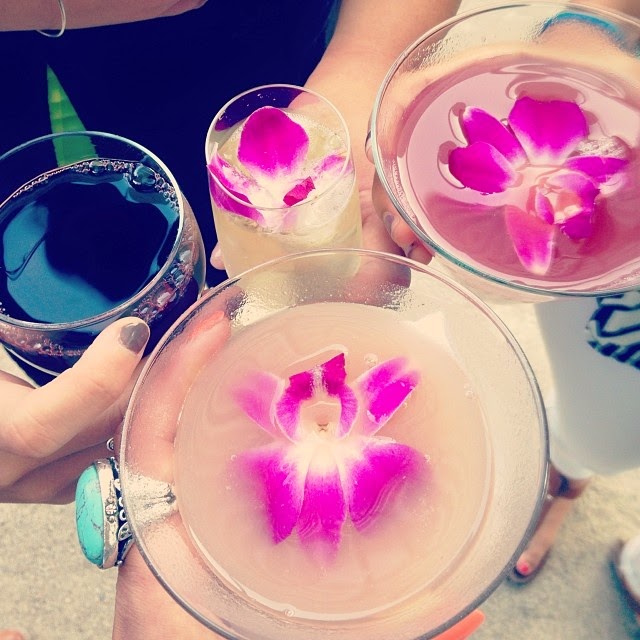
One of our recent trips was to the Art Institute of Chicago. Last month we went to the AIC for Martini Mondays, a summertime event bolstering “libations, light bites, live music and special exhibition viewings.” This particular program (different from the monthly “Art After Dark” and “Night Heist” events the AIC already hosts) varies from month to month in location, trying to make use of the outdoor spaces of the museum before leading inward to a particular exhibit inside.  July’s event started off in the Pritzker Garden – the bright, sunny courtyard amid the trees, located off the east side of the Modern Wing.  There were several tables offering generous amounts of antipasto options (the Art Institute provides some of the best food at these events), as well as a few bartenders mixing up pretty martinis (pictured right!) and the standard bar classics.  Visitors dined and sipped as the sun lowered in the skyline, all to the tune of a live jazz band at the end of the courtyard.  It was as lovely as it sounds!

Post-martini, this event was to lead back inside for a special look at the “Chicagoisms” exhibit.  Sadly, there was a miscommunication and “Chicagoisms” ended up being closed that night, so the museum instead had the Classics hallways opened for the guests.  Although I had been looking forward to viewing the “Chicagoisms” architecture exhibit, this was no great disappointment.  The cool blue hallways hosting the Greek, Roman and Byzantine works are among my favorite spots in the museum - for the jewelry, artwork and sculpture as much as for the views overlooking the pretty garden and fountains of McKinlock court below.  As an added bonus, we got to watch the sun finally disappear behind the buildings downtown.

The sun sets over McKinlock Court


This event provided visitors all the best things that summer in Chicago has to offer.  The weather was perfect, and it was easy to see why the AIC would add a third program to their already full schedule of social events.  The gardens of the museum are so peaceful and visually beautiful, and yet we are only offered a few short months to enjoy them.  Incidentally, tonight is the last Martini Monday of the summer.  So get yourself there before the summer does officially end!  You can go here to buy tickets.

Friday, August 1, 2014

Cartwheeling

Since early May, Museum Explorer has really been “with the program,” so-to-speak.  It kicked off with the release of our article on program carts published by the National Association of Museum Exhibition (N.A.M.E.) in their Spring issue of The Exhibitionist (vol. 33, no. 1, Spring 2014). The issue, dedicated to ‘Intentionally Designed Spaces,’ includes our contribution “Exhibition Carts: Intentionally Design Spaces on the Move” by Museum Explorer staff, Rich Faron and Jessica Banda. The article is still available from N.A.M.E. on their site (here), but here's a refresher excerpt:

“Program carts are wonderful tools for responding to this increasing pressure facing exhibitors. As a method of flexible program delivery, these carts provide activities that fulfill a variety of purposes, from conveying mission content, to serving as a changing marquee, to supporting local school curricula. Because carts bring staff, objects, and an exhibit-like experience into direct contact with visitors, they provide an intimate and simple means for establishing and building a dialogue with the public.”

Our article was so well received that of the dozen articles published in that issue, ours was among only 3 that were selected to be highlighted on the N.A.M.E. web site and made available via PDF through a link with their web site.

But…that wasn’t even the biggest deal.  In May N.A.M.E. invited us (Jessica Banda and Rich Faron) to participate in a Twitter Chat that was by all accounts, including our own, a huge success.  The chat was hosted by on June 26th by Dana Allen-Greil (Digital Outreach Manager at the Smithsonian Museum, National Gallery of Art), and included participants from museum of all kinds from all around the country. If you missed it you can still recap and read the tweets by clicking the link.

But wait - that’s not all! It’s one thing to write, talk and tweet about carts, but in the end the most important thing is to actually design and build carts!  We’re proud to report that we are currently designing and working with our fabricator on 3 brand new cart designs for Lincoln Park Zoo, the Brevard Zoo in Melbourne, Florida, and the Naper Settlement in Naperville, Illinois.  Additionally, we’ve been developing some brand new program materials for the History a la Cart programs at the Chicago History Museum!

So…we are keeping busy!  But so far it has been a great summer and here’s hoping that it keeps on ROLLING!


Tuesday, July 29, 2014

Something Good Brewing at the Field Museum!


Hopefully, by now, you have gleaned this point from us – but museums have come quite a ways from quiet, stuffy places where you can walk but not run and look at but not touch the things behind the glass.  A museum is not a place reserved only for field trips to be led by stern, stuffy people droning on facts.  Museum people are constantly finding new ways of redefining the word: be it updating public spaces, bringing the museum to non-conventional spaces, or simply taking you behind the glass.

In a recent push to stay contemporary, many museums have developed “night series programming,” offering a chance for 20- and 30-something museum-goers to be ushered into the museum in a more social setting (not to be confused with the very cool overnight programming for younger children that many museums also bolster).  Fortunately for Chicagoans, all of the local big museums offer many such events—and we were pleased to go
Jim and Jason Ebel (the Two Brothers)
to the Field Museum’s newest such offering, “Hop to It! At the Field.”   The Field Museum collaborated with Two Brothers Brewery and chef Cleetus Friedman to create Cabinet of Curiosities – a very tasty white IPA with hints of coriander and citrus. This event was held very simply to celebrate the release of that creation - and what fun it was!

The night started with the food pairings Friedman created for the event, as well as a generous tasting of the new release Cabinet of Curiosities. For all of the other beer-loving museum-goers out there, this event was certainly worth the money – guests were provided 6 (six!!) drink tickets upon entry, which allowed you to get a taste of everything they had to offer on tap at the Field Bistro, as well as a commemorative glass celebrating the release (if you got to the event early enough).  The Curator of Anthropology, Jim Philips, was on hand to give a rare intimate demonstration of ancient methods of beer production and storage.  The Two Brothers themselves then spoke for a bit to explain the collaboration process with the Field Museum in creating their new brew, there was another toast, and everyone was able to move into the Stanley Field Hall to enjoy more food, drinks, and live music.

 
In Conclusion:  Cabinet of Curiosities is great!


This is only the second such event the Field Museum has done, but you would never know it.  As far as the nightlife events at museums go (which are becoming ever more popular), this is the best one I’ve attended.  This event felt different than some of the other “after dark” events I’ve been to at the museums – meaning it was a little bit more sophisticated, lacking the enormous lines for the bathrooms, and fortunately devoid of (most) of the sloppy drunken socialites.  It was organized, thoughtful, and fun, so they have definitely brewed up a good thing!  We’re looking forward to the next event they host.  But in the meantime, you don’t even have to go the South Loop for a taste of the Field Museum – you can try Cabinet of Curiosities now at your local supermarket!