Saturday, January 17, 2015

Frank Lloyd Wright's Beacon of Light: A Step Back in Time Inside the Robie House

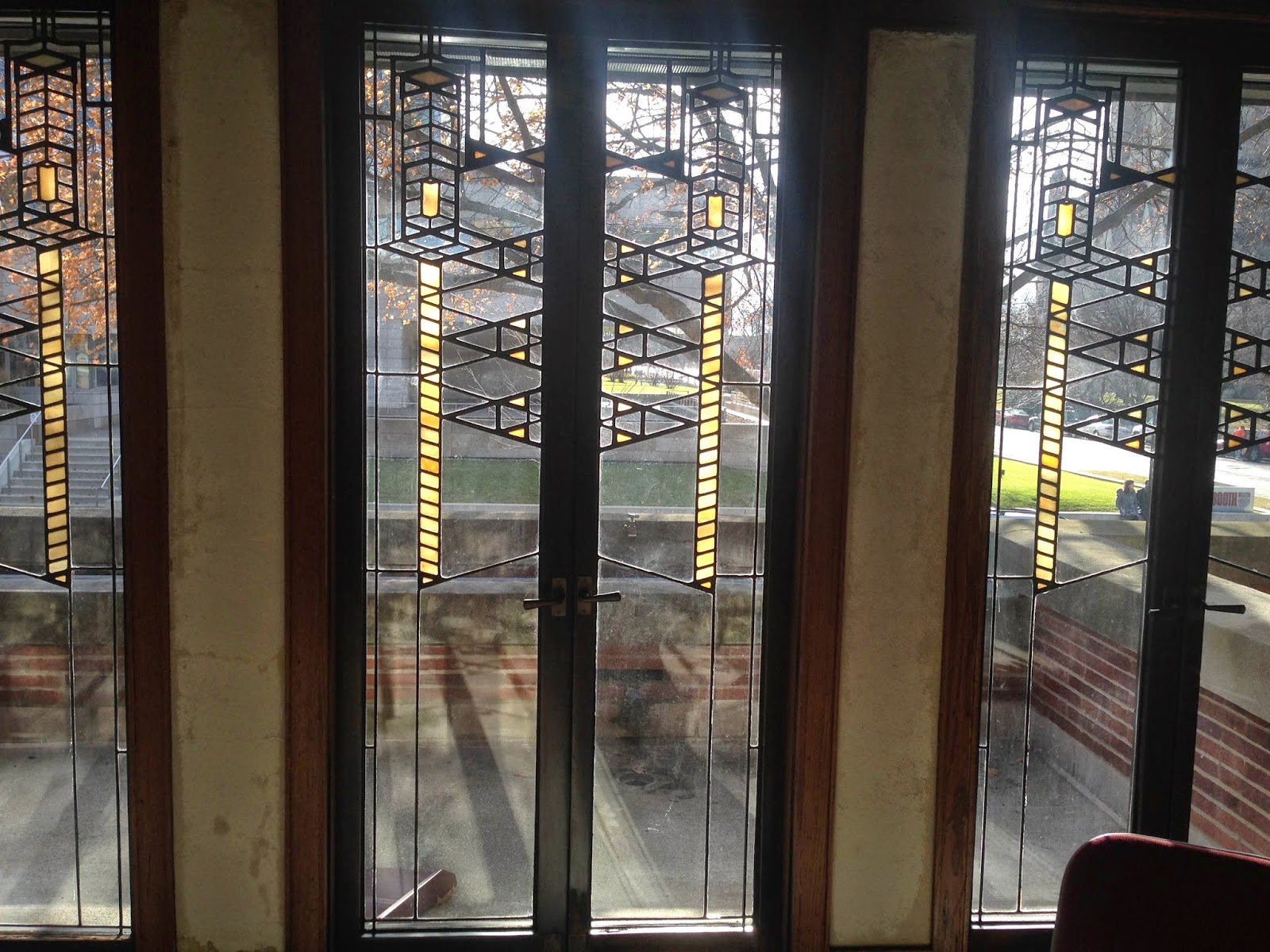
The "Wall of Light":  Art Glass Windows on the South Side of the Robie House

I've always felt that Hyde Park was one place in which you can still feel the presence of old Chicago (see our post on the 1893 World's Fair HERE).  One of the older suburbs of the city (which it remained until Chicago officially annexed it in 1889), Hyde Park maintains many of its old vestiges.  Driving south of the city nearing its Midway Plaissance, the lake seems calmer, and it seems a little quieter amid the park grounds, old homes and university campus in the area.  Hyde Park still has that old feeling to it which is both urban Chicago and suburban at once.

It’s no wonder, then, why a budding businessman, husband and father of two young children would select the location for his home to be built.  Frederick C. Robie commissioned Frank Lloyd Wright for the job some time during 1908, and construction began on the Robie House in 1909.  Wright’s Prairie style gem was completed in 1910, now over a century ago.

The history of the house itself is pretty fascinating, having changed hands several times in the subsequent decades (once even having served as a dormitory!).  Today it is operated exclusively by the Frank Lloyd Wright Trust.  It stands as a tribute to Frank Lloyd Wright, an exemplar of some of his best and most iconic work.
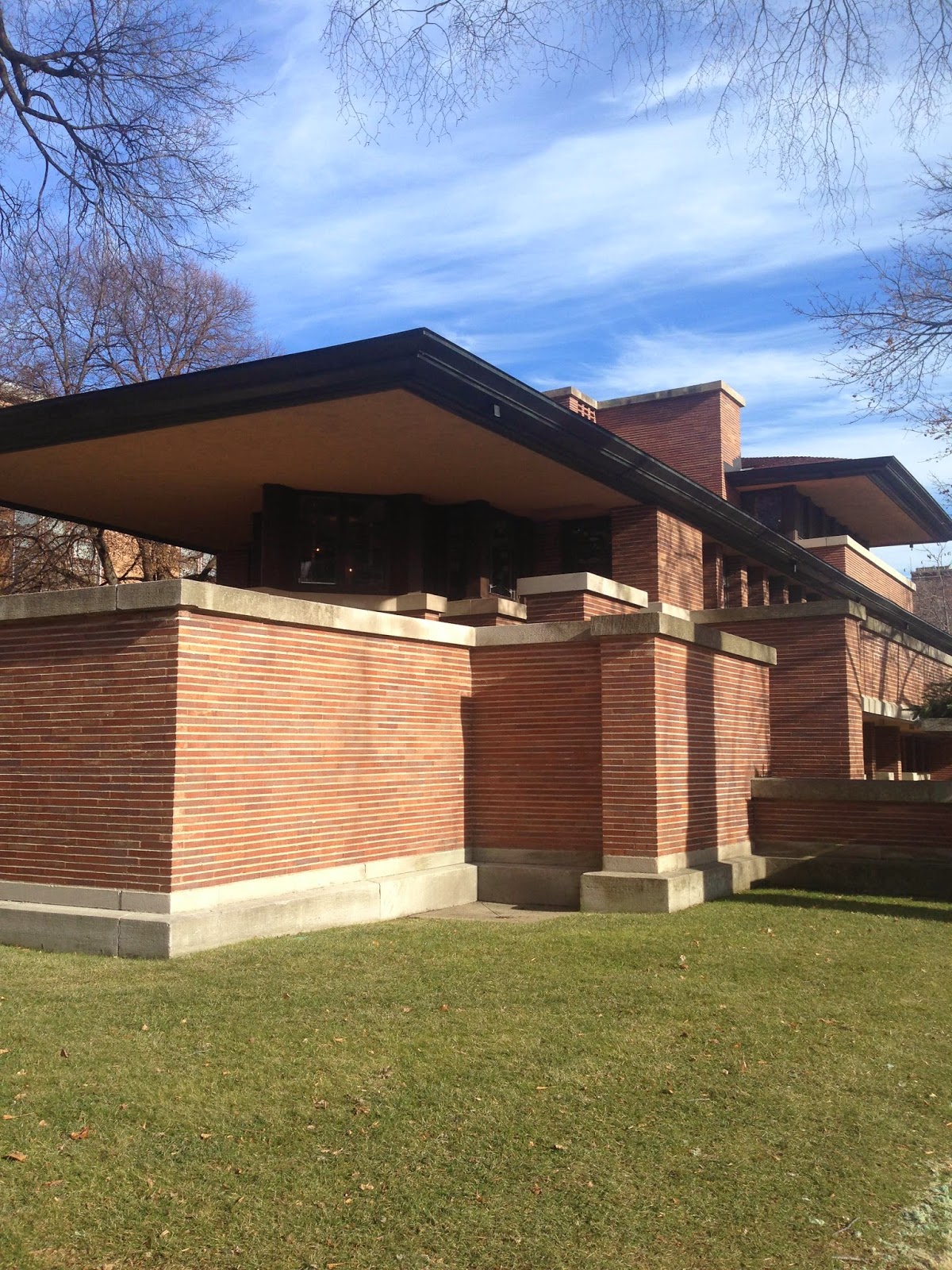
The Frederick C. Robie House, as seen from outside
In fact, even today, the house stands out in the neighborhood.  While there are now newer and more modern-style buildings around than there were in 1910, the Robie House still shines among them as an example of modern architecture.  Just think, how unique the style was for 1910!  It would have been alone amid the other Queen Annes, Victorian style homes which were in fashion at the time.  The straight lines and cantilevers on the Robie House were quite the converse of the neo-Gothic curves on the Queen Annes. 

It’s something really incredible to be able to forge a connection with the past, and in the Robie House, it’s like taking a step back in time.  The Frank Lloyd Wright Trust guides offer a fascinating tour of the place.  They are quick to point out the nuances of the house, and made it so easy to see the genius in Wright’s designs there.  Actually, it’s hard to believe that this place is over 100 years old, given the forward thinking in the design, the modern straight lines throughout, and the incredible built-in functionality of the house.  Among my favorite features were the “hidden” radiators, designed by Wright to be encased in decorative wooden covers so as to unify form and functionality.  There are plenty more points like this in the house, such as the outdoor planters that are built into the home, replete with their own irrigation system!  Frank Lloyd Wright didn’t skimp on the details in the design of this home.
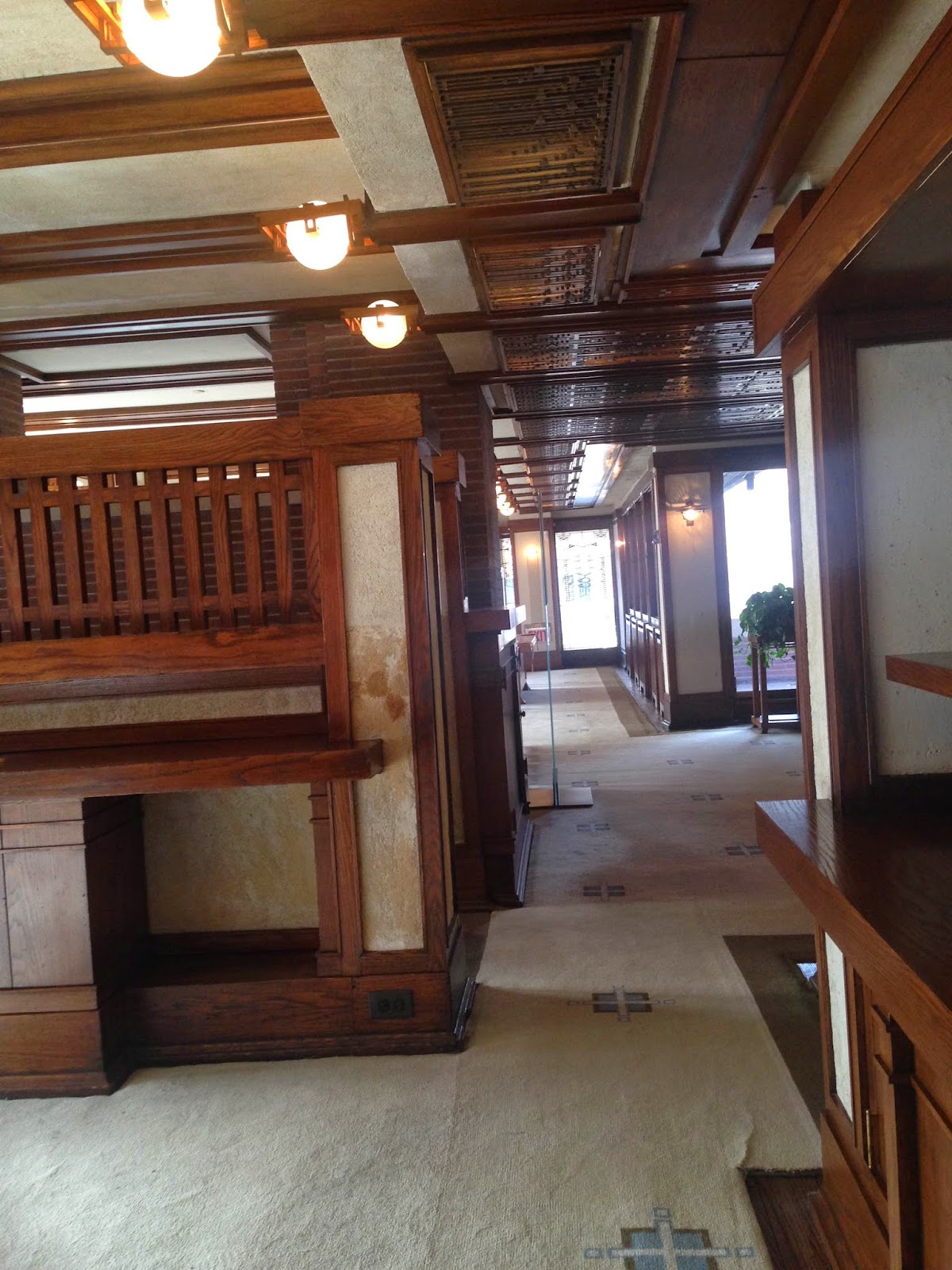
Paint swatches are visible here
Also noted by the tour guides, and obvious to the naked eye, was the disrepair of the house.  This was obvious in the broken, exposed wall sconces, the in progress paint jobs occurring on the walls, the windows being replaced.  That is not to say that the Robie House is in any state of ruin—repairs are being made and restoration is in progress, fear not.  It was just so striking to see the wear on the building throughout the tour.  Maintenance is not something museum goers ever really get to witness or have to think about, because that’s usually done behind closed doors, after hours.  But in this case of the Robie House, the museum and exhibit is the venue itself.  The tour pointed out how much upkeep is required to preserve a building in its original state, and just how much work the Frank Lloyd Wright Trust has to do to keep Wright’s beacon shining.
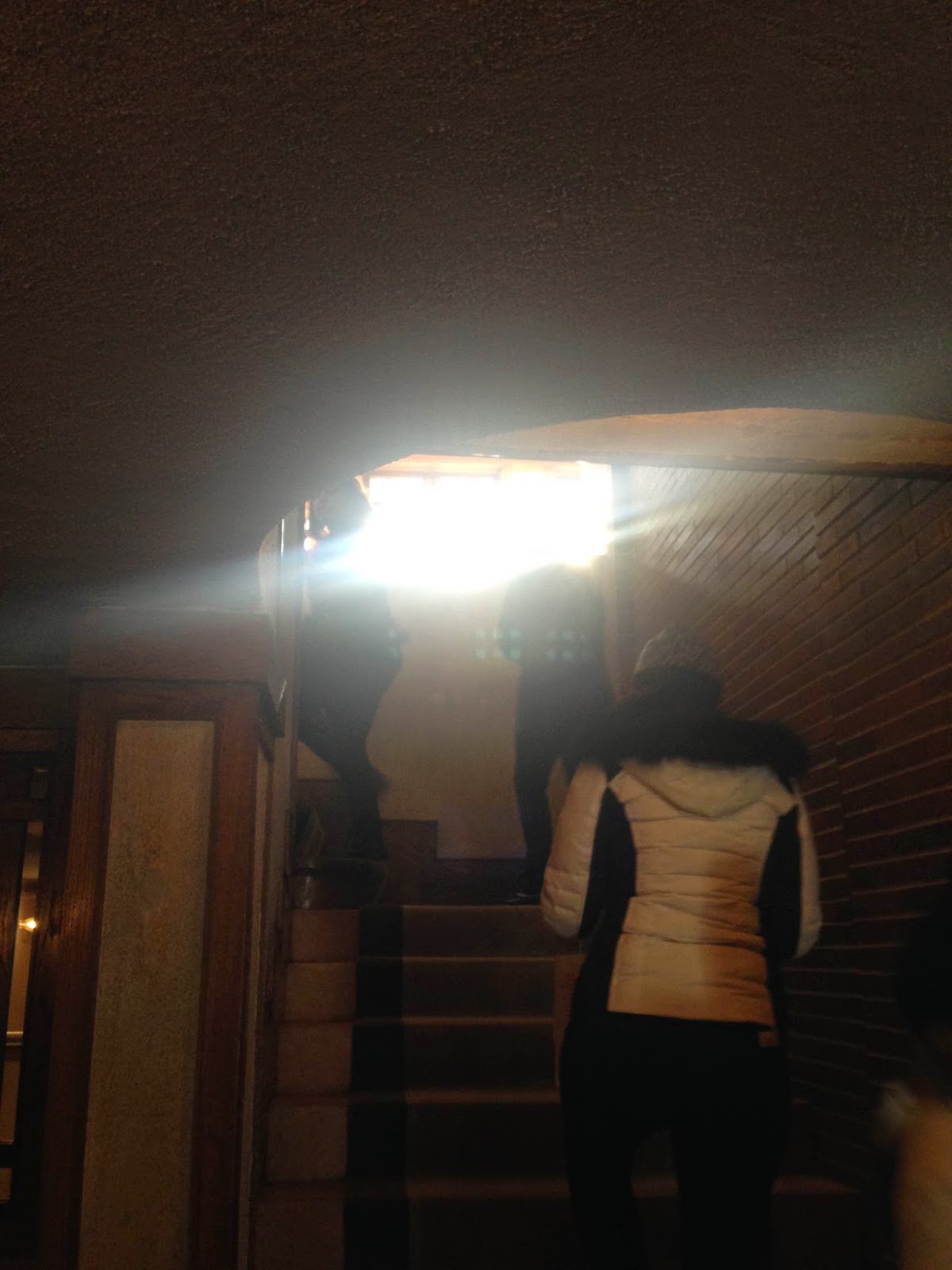


Light peeking on the Stairway
But that's not to talk down its beauty. I snapped some unauthorized photos during the tour, and if nothing else, you can clearly see from these pictures that the lighting in this house is gorgeous.  The first photo above shows the lighting from the staircase of the original main entrance of the home leading up to the living room.  In order of the tour and the progression through the house, next is the “wall of light,” the literal wall of windows on the south side of the home that runs from the living room and the dining room.  Fortunately on the day of this tour a few weeks ago, we had great sunlight, pointing out that shining is something that the home still does well, even after a century.
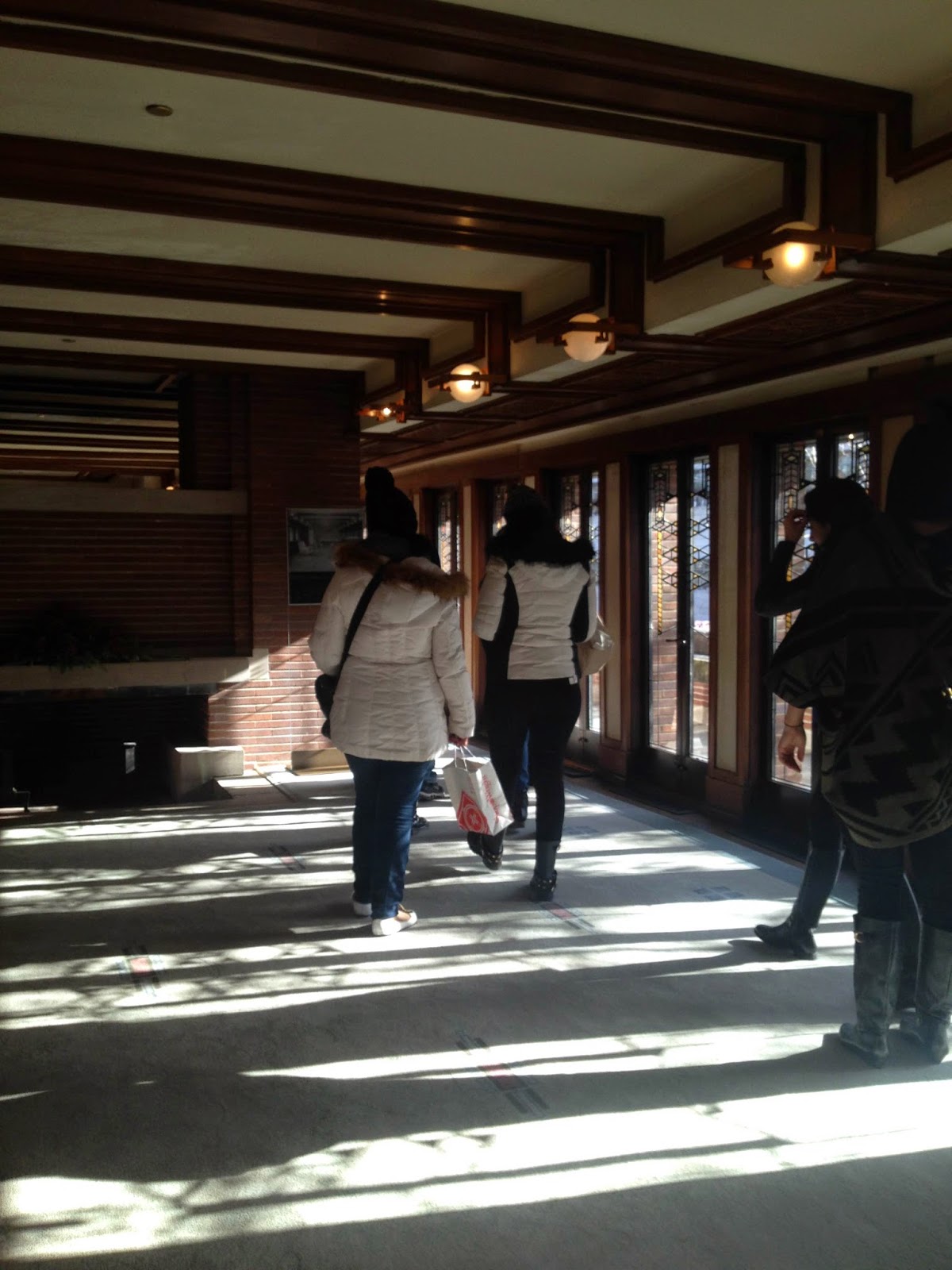


Walking from the Living Room to the Dining Room, through the Light

Saturday, January 3, 2015

Reflection for the New Year


Happy New Year to all you MuseumX fans!  For our first post of 2015, we (predictably) will be doing some reflecting on the past…  Although we are going back kinda far this New Year—from 2015 all the long way back to 1968.

As 2014 has come to a close, so too will “The 1968 Exhibit” at the Chicago History Museum (tomorrow is the last day to catch it!).  Fortunately we did not drop the ball before the ball dropped - we were able to attend a special viewing of it last month!

To be honest, I was not thrilled about the subject matter of this exhibit, solely based on personal preferences.  The 1960’s are generally a period of American History I have always been uninterested in.  My parents are products of the mid-60’s, and my mother is nostalgic, so she always had on TV sitcoms from the era..  As a kid, these bugged me because they were A) not animated and B), unbelievably not-funny.  So much of what I reluctantly digested from the 60s, I disliked, because it was not relatable.  As I grew older and learned more about the Civil Rights Movement, the American political system, the Vietnam War, my disinterest was sustained.  What a sad, sad time.  To have an exhibit that highlighted so many of these central events and themes of the 1960s, was not that exciting to me.  Fortunately, my mind was changed very quickly upon entering the gallery in the Chicago History Museum.

The foremost recollection of this exhibit is the entrance, because it is so striking.  The first space within ‘1968’ is at first, a normal living room by 1960s standards: golden brown, straight lines, wooden furniture, more shades of brown, and, a television set.  Next in the order of the living room properties is an actual “Huey” helicopter, to denote the heavy presence of the Vietnam War in the thoughts (and tv sets) of Americans during the war.  It’s a powerful and provocative image.  The staging in ‘1968’ is pretty well done elsewhere in the gallery, too—my favorite “scene” is the desk of a typical young woman in her 20s during the 1960s.  While the technology has shifted a bit from the blue typewriter featured on this desk, I can firmly say that the general set up of the room (political posters, colors, birth control) remains the same (being friends with several female new-age hippies currently in their 20s).

Desk of a "Modern Woman," from 1968
Actually, this very characteristic of ‘1968: The Exhibit’ to me is what was most surprising, and most rewarding: the events presented during 1968 are presented in such a way that they are totally relatable to the happenings of 2014.  While ‘1968’ is nostalgic to many of the museumgoers that lived through the year themselves, I have no personal ties to the 60s.  Although I was not really turned on by the subject matter of the exhibit, I was able to enjoy myself moving through the year of 1968, both learning new information about these events, and relating them to events that are happening this day in age.


One of the many graphics on Race Issues in 1968
At no point was this relatability more clear than at the station in the exhibit dedicated to Martin Luther King, Jr.  Watching the featured documentary clip, listening to his words on oppression, violence and peace, was so eerie.  The violence and racism of which he speaks has not really changed at all, although 46 years have passed since that time.  Ambling through the exhibit, you will see words like “police brutality,” “violence,” “racism,” and “equality” appear at multiple points during that year.  Although the exhibit provides great context for these words and corresponding events, none is needed.  These words, these struggles and instances, are still occurring.  In light of the recent tragedies in Ferguson and New York, to name just a few, it was striking to look upon these acts of violence that happened in 1968 and know that we have made little progress since. The Civil Rights Movement remains ongoing all the way into 2015.  I was grateful “1968” was able to make me look at my own day in age differently.


Food for Thought: Up top, from 2014, below, from 1968

Friday, December 19, 2014

How Lovely Are Your Branches: A Christmas Trip to the Arboretum


Earlier this week, you may have noticed, we trekked to the Morton Arboretum.  That’s right—it is December, and it was a mere 30° outside, but what a night!  We went to see the “Illumination” exhibit at the Morton Arboretum, a mile-long stretch of trees decked out in all kinds of lights and color. 


These were not just any Christmas lights!  Although there were plenty of conifer trees on display, the lights shone upon trees and hedges of all sizes and shapes at the Arboretum.  It was literally like walking through the Disney classic “Fantasia,” what with all the incredible colors and the Classical music (from our very own Chicago Symphony Orchestra!) being played from the speakers.  The ‘Symphony Station,’ which you see pictured to the right and above,
 was particularly awesome.  This was a new addition to “Illumination” this year, with the lights both on the floor of the forest (!) and those projected on the trees synching up with the Classical music.  Just incredible.


Here are some more photos from our tour of “Illumination,” but try and get to the Morton Arboretum to see for yourself—you only have until January 3rd!


Monday, December 15, 2014

Congrats!


Cheers to MuseumExplorer's very own Gini Kondziolka!  Our Graphic Designer has just had one of her paintings selected to hang in the State Office of the Lieutenant Governer.  Gongrats, Gini!

Friday, December 5, 2014

David Bowie Is...


To answer the question, read for yourself!

For me, the thought "David Bowie Is" has always been followed by an ellipsis...  It was never a full sentence, just a question that sort of trailed off and I never answered for myself.  Not that I tried, but I couldn’t get a grasp on him—is he a movie star, a musician? Never having listened to his music, or seen Labyrinth as a child (the brink, I think, of Bowie fandom for my generation), Bowie always remained an intimidating enigma to me, whose multiple roles I never delved into further contemplating. Well, that changed Saturday night when I went to the Museum of Contemporary Art.

The exhibit now showing at the MCA uses the phrase “David Bowie Is” as a title.  Though it seems a pretty definitive statement, it is presented without punctuation.  It’s an open-ended invitation to you the museum goer to finish the thought however you'd like, whatever you say is probably right… This, to me, was still a little trepidating.  Having majored in English, I’m pretty attached to my punctuation.  It makes sense that the title wouldn’t have a period, because it wouldn’t be a complete sentence--and because Bowie is still alive.  But then why get a retrospective exhibit? He's not retired, he's not really the sort of artist that would be featured in an art museum.

The exhibit uses the term “David Bowie Is” playfully throughout, in mock matinees, in posters spaced throughout the exhibit. Actually, the phrase itself is used (playfully enough as punctuation) throughout the exhibit. “David Bowie Is” will begin the sentence on a poster/matinee in different rooms in the exhibit, with various endings.  Thus, there is in fact no wrong ending to that phrase, because David Bowie is so many things.

A poor example of the costume staging and use of multimedia
And, in exploring that idea in the makeup of the artist, many other artists, musicians, authors, are cited.  Prior to seeing this, I expected (correctly) that this retrospective exhibit might echo that of the Alexander McQueen exhibit, “Savage Beauty,” given at the Metropolitan Museum of Art in New York in 2011.  As Bowie is a fashion icon himself, many of his costumes and outfits were displayed at the MCA for “David Bowie Is.”  And indeed, they were dramatically staged as runway mannequins, not unlike those designs of McQueen in “Savage Beauty,” down to the lighting. This worked out though, given the drama of so many of his outfits, and especially given that McQueen himself designed several costumes for Bowie.

Costume was not the only medium on display.  Everything from music videos, to creatively staged motion projection, photographs, journals, notes, and countless other artifacts are on display at the MCA attempting to give a grasp on Bowie's incredible body of work. I had no idea just how influential he was until having seen a preserved tissue of his from a concert in the 1970s. I had no idea just how widely influenced he was until seeing his notes on a copy of a novel he read.

The essential audio tour fit in nicely to this multimedia aspect. Now, if you recall our post about the recent Magritte exhibit at the Art Institute, you know my qualm with audio tours at museums. I hate the invasive ones, and I almost never partake in them myself because I don't like my interpretations or exhibit experience to be guided by a pre-recording. This audio tour, however, was truly stellar. It actually automatically synced up to whatever station of the exhibit you were in (confession: I had more than a little fun stepping from spot to spot just to make sure that the tour’s motion sensors kicked in). Perusing that powder blue Bowie once famously donned, you might overhear soft audio from an interview with Bowie, and then it would kick into “Life on Mars?,” which you would realize was synced up to the music video being projected on a wall nearby, featuring that very suit. There was so much visual and audio stimulation from one moment to the next in this exhibit, but not so that your eyes and ears didn't know where to focus. It all flowed very nicely.


Now having gotten a glimpse at what “David Bowie Is,” I can confidently say that Bowie remains evermore mysterious, though more intriguing than intimidating. He is a movie star, and yet a recording star, and yet an actor, but now after a peek under all of those hats, the multiple roles make more sense.  And this exhibit revealed even more hats that I was not aware of--designer, makeup artist, fashion icon, voracious reader and a pretty talented student of other icons and musicians.  But getting a closer glimpse into his process on all the media and platforms available in this exhibit, it is clear why “David Bowie Is” has no punctuation: because that ending is continually being altered and rewritten and added to.


"David Bowie Is" only here until January 9th, so make sure you catch it before it leaves!


Saturday, November 15, 2014

Feigning Wealthy for Halloween: A Night at the Driehaus Museum


Awaiting the Swing Gitan Concert in the Ballroom

As I am reluctantly putting away my Halloween decorations and swapping them for Thanksgiving trimmings (obviously desperately wishing it was not already winter weather-wise), I realized we forgot to share what MuseumX did for Hallow’s Eve!  For Halloween, we pretended that we were among the wealthiest of members of the upper class in late 19th century Chicago.  Fortunately for us (get it), that did not require us to dress in period-appropriate costume, but it was still an immersive experience nevertheless!


The Driehaus Museum held a concert one Friday evening last month, featuring the musical talents of Alfonso Ponticelli and Swing Gitan, a Chicago gypsy jazz band.  For those not familiar, gypsy jazz is a style of music combining gypsy musical elements (including some gypsy songs, and instruments such as the violin) with jazz standards and swing elements, played on acoustic instruments.  It’s a style chartered by Django Reinhardt (the Original Gypsy) in France during the 1930s, and yet, we learned that night, still sounds and feels completely fresh and extemporaneous.

Being that we arrived late to the chapel-style event seating, we didn’t grab a great view (or photo) of the band, or the instruments.  The photo atop this post was taken from our seats toward the back of the room.  You can see that the staff added a bluish green filter to the lighting, which was perfect for the mood of the music.  Generally speaking, gypsy songs tend to favor the minor key, and there are dark elements to the tone of the music (the song “Dark Eyes,” for example).  So, the bluish tinge upon the dark mahogany wood of the third floor Ballroom lent a lovely setting for the moody and music. Fortunately, the acoustics were plenty good from where we sat! 

Ponticelli, the lead guitarist of Swing Gitan, and started off the concert with a solo song.  Afterwards he introduced the rest of the quintet, who played rhythym guitar, bass, violin, and a cimbalom.  If the setting of this concert wasn’t enough to take you to another time, the cimbalom definitely was.  This instrument sort of looks like a small piano with strings across the top of it, and is played by striking beaters against those strings.  It is hardly ever used in contemporary music, and was incredible to hear live.  The talent and artistry among this group of musicians is truly amazing, and I’m so glad I got to witness that in person! 

If in our last post I lamented about history not being well preserved enough, the Driehaus Museum offers a fabulous counterpoint to that complaint.  The house itself-a late 19th century Italianate mansion once belonging to Samuel M. Nickerson-has been fully restored and preserved, not to mention furnished and decorated with period-appropriate pieces by the Richard H. Driehaus foundation.  Although we did not have enough time during this visit to fully explore the floors of the museum, we do have several pictures of rooms on the first level of the mansion.  Here you can see a photo of the Gallery, underneath the beautiful stained glass dome.  The attention to detail here with the furnishing and decorating is truly exquisite. You feel as if you had walked into the Nickerson’s house only seconds after they left it.   

And, though a prime exemplar of historic preservation, the Driehaus Museum is among Chicago’s most immersive.  Imagine your grandmother’s carefully decorated living, which she may or may not have taken precautions to preserve herself (vinyl sofa covers and/or carpet protectors).  Imagine the rebuking you would get trying to play or, heaven forbid, eat in that room… Talk about a scare!  Yet here at the Driehaus museum, you can walk among these opulent decorative pieces, and are even invited to have a drink inside the Ballroom—no vinyl coverings to be found!  Here, if you want to get closer to a piece at the museum, you will most likely not be stopped by glass casing, nor an alarm warning you that you are too close.  So, although the period and decorations of the mansion and the glory years of gypsy jazz were not contemporary, the Driehaus was a fabulous setting for this jazz concert.  Why shouldn’t a museum known for historic preservation host a band keeping the music of the 1930s alive?  There was no costume necessary for us to feel as though we were living history!


Friday, October 17, 2014

Failure, Fondness, and the Few Remaining Wonders of the Chicago World's Fair


Earlier this week I mentioned a point where I was not so timely in getting to an exhibit.  That time—more specifically, a 9-month span—was my failure to make it to the “Opening the Vaults: Wonders of the 1893 World’s Fair” exhibit on the 1893 World’s Columbian Exposition at the Field Museum.  It was a failure of epic proportions, truly.  In typical fashion, I waited until the absolute last day of the exhibit to attempt to go—a day which also happened to be the home opener for the Chicago Bears’ 2014 season.  I waited until 3:00pm on this day to try to go to the Field Museum—a time which also happened to coincide with the end of the Bears’ loss that day.  So I ended up waiting some more, in traffic, for two hours—the first hour trying to venture eastbound to get the Museum campus (to no avail), the second hour in more traffic trying to get home (I live approximately 5 miles away).  So with all this free time to spend in gridlock, I got to thinking about what I’ve already seen from the Chicago World’s Fair – the 1893 World’s Columbian Exposition. 


Several changes have been made to the city since 1893.
Turns out, I’ve been to a few attractions already this summer.  First we’ll start off with my most recent ride on the Ferris Wheel at Navy Pier.  To clarify, this is not the original Ferris Wheel that was built purposely for the fair—that one was dismantled in 1894, relocated and eventually demolished.  The Ferris Wheel at Navy Pier stands in honor of that Original, however.  At least, that’s what the radio tour that plays during the ride would have you believe.  There is actually little relation between the two attractions.  Whereas the Navy Pier Ferris Wheel stands at 150 feet high, the Original was a whopping 264 feet tall, a fact that literally made me get butterflies as it was recited to me from above Navy Pier via the radio inside the gondola (view on the right!). Nor are the sites of the two wheels close.  The Original was located on what is now park ground next to the University of Chicago campus in Hyde Park – a stretch that still maintains its original name from the fair: The Midway Plaissance. 


Osaka Garden - a view of the Moon Bridge

Actually, Hyde Park is the location that holds most of the remnants of the 1893 World’s Fair.  That is where you will find the Osaka Garden, near the lake right off of the Midway Plaissance.  Located in Jackson Park on the Wooded Isle, this garden was constructed as an exhibit in the Fair, at the behest of the Japanese government.  While the garden remains located on the original location from 1893, it had to be reconstructed after having been vandalized during WWII.  Turns out the park has an interesting history of its own (which you can read about here).  What stands today is what you can see here in these pictures I took: a beautiful Japanese strolling garden, with several ponds, a waterfall, plants, trees, a Moon bridge, and the pavilion a few steps away.  From this view, only steps away from the lagoon the garden shares with the Museum of Science and Industry overlooks, it is easy to imagine how the grounds may have looked in 1893. 


Can't you picture the gondolas?
The Museum of Science and Industry is located in a building which originally was the Palace of Fine Arts for the Fair.  During the Fair, the South entrance of the building was the main entrance, where visitors sailed up in gondolas from the North Pond (today known as the Columbia Basin, which is part of the lagoon the building sits on).  While the Museum of Science and Industry is indefinitely worth a visit of its own accord (which we will grant soon enough), this fine summer day I visited, I could not help but imagine what the building was like during the 1893 World’s Fair.  It was the inspiration for this wistful picture you see here (personally, I think it was mildly cruel of the museum to leave these doors open and forbid people to walk out through them).  Never have I felt more nostalgic than on this day at the South entrance of the Palace of Fine Arts.  It literally pains me to look at the breathtaking pictures from the Columbian Exposition (particularly the images of the Court of Honor) and know that we have so little left of those many works of art.   Add to that my failure to visit those few remaining wonders at the Field Museum exhibit… Talk about pain!